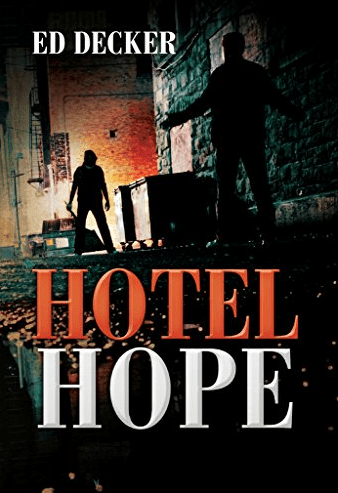
Ed Decker
Introduction
The old man stood in front of what was once an elite boutique hotel for Chicago’s wealthiest people. The Manor House had long ago lost its glamour and now sat there as a broken relic of the past, surrounded by weeds, cyclone fencing and razor wire.
Father Ruben Stone had been sent there, removed from his mountain village parish after 50 years of ministry, now a widower who was supposed to wait out his last few years in this worn-out retirement home for elderly men and women who, according to the church, had past the age of acceptable usefulness.
Little did he realize that his life would take an extraordinary turn and this old hotel would become a hotel filled with hope and fulfillment.
While Father Ruben was traveling south to Chicago, a man filled with an abhorrent evil was coming north to Chicago. This man would begin a vicious killing spree of the most ghastly sort.
His killings were what some recognized at Masonic ritual murders. They would become more brutal as time went on and he often left his brutally murdered homeless victims sliced and maimed beyond recognition. He was an invisible shadow to the police who seemed helpless against his cunning.
Finally, one cold and wet night, Father Ruben crossed his path and snatched a homeless mother and her little children from his grip. That night, the killer determined in his rage that the old priest must die an especially terrible death for his interference.
Finally, the two paths do intersect in a fierce and violent encounter. But is good victorious over evil or does evil have its bloody way with good?
PART ONE
Chapter One
Remembering
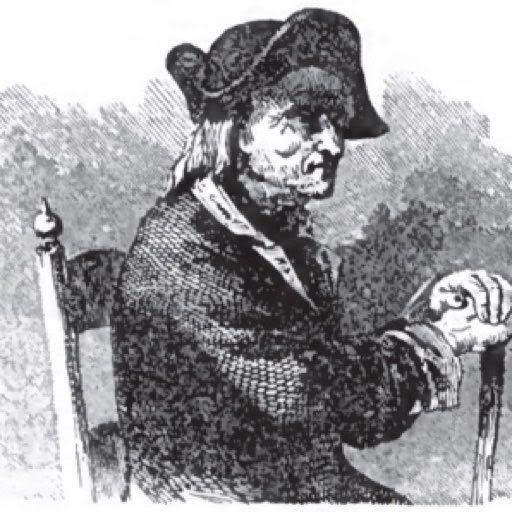
The Old man slowly pushed through the rusted wrought iron gate of the small cemetery, stepped onto the well-manicured grass as the rising sun reflected its early morning light across the lake below, and sent sparkling gems of dew across the hillside. He stood at the entry; his shoulders bent, his lips moving, mouthing words, their sounds whisked away by the early morning breeze. Tears formed and slowly worked their way down his cheeks, dripping off his chin. He made no move to wipe them away.
He walked in a crisscross pattern among the gravestones, stopping at one here and one there, laying his wrinkled, blue veined hands on the cold, wet granite as he spoke quiet words to the dead. His path seemed random, but he had specific intent. He had come to say his final goodbyes to old friends and loved ones.
He finally lowered himself slowly to the ground, wiping his tears across his sleeve as he sat quietly, his back against the thick trunk of the giant Maple tree in the center of the cemetery. The rising sun was still low in the horizon and it sent its early warmth to him. The arrows of light shimmered across the lake caught his eyes and he brought his hand up to shield his sight.
He looked up at the thick foliage, thinking the old tree was probably 150 years old, planted there when the first graves were arranged around it. Now it towered over them and sheltered them, adding a bright green leafed canopy that glistened its reflection off the glossy monuments to the dead.
He was startled to see a large Great Horned Owl perched on an outer limb, staring down at him, its wings back in an attack mode, its yellow eyes with those deep black cores piercing out at him, challenging him for this hunting blind.
The old man tried to scramble to his feet and run but as he struggled to rise, the owl flew off, skimming the lake and disappeared into the orchard.
He chuckled, remembering a book he had read some years ago about an Anglican Vicar who was terminally ill. He had been sent to an Indian tribe in Canada and learned their belief that when it was your time to die, an owl would call your name.
Well, this owl did not call my name, so I guess I am safe for now, he mused.
He sat back down and rested against the massive trunk. He breathed deeply and sighed as he inhaled the sweet morning smells of the tree and its leaves, reaching out to taste the morning sun. Such tranquility. Such harmony with God’s wonderful creations.
He knew that the next time he entered this peaceful place, he would be in a simple wooden casket, come to join his wife, Elizabeth and his parents. He wished that it were he who laid buried here and not his wife. The pain of leaving her alone in this place racked his whole body and the silent tears flowed once again as the thought of what lay ahead today consumed him.
From where he sat, he could see her headstone and the one next to hers, with his mother and father’s names on it. He was not ready to say that final goodbye yet and lingered, watching the morning sun continue its daily path, rising higher until it left him in the protected shade of the giant tree.
He gradually worked his way to his feet and with a deep sigh, slowly walked out to the edge of the cemetery. He leaned against the white picket fencing that marked the limits of the graveyard. He fought against a smile as he looked down from the hillside and saw the mist rising from the lake below. Its beauty at dawn always touched his heart. His wife loved to walk along its grassy banks and through the orchards.
When they were young, she would pull him out of the rectory at noon on many of the warm summer days and drag him to the lake for a picnic lunch. So many years ago.
Denning Lake was an overflow waterway for the Herons and Canadian Geese that usually populated the waters of the nearby Horicon Wildlife Refuge to the west of them. His reluctant smile widened as he watched a wing of geese floating lazily along the near bank. A small Red Fox trotted alongside them, hoping they would flush a mouse or two out into the open for his breakfast.
Terraced along the rolling hillsides that held in the lake were the well-groomed apple orchards. They were the main reason the small village of Denning Lake had survived since the first settlers planted the original orchards in the late 1840s.
The apples were still the main source of village income and were quite well known. People as far away as Fond du Lac and even Milwaukee made their annual pilgrimages to Denning Lake each fall to load up on the large sweet tasting Connell Red apples for which the Denning Orchards were famous.
The low acid, sweet tasting beauties were as flavorsome and juicy as apples could get, good for eating, baking, and made great apple juice and cider.
Another smile broke through his melancholy as he thought of the many hundreds of apple pies Elizabeth made for him and the many members of the church over the years. No one made piecrust like Elizabeth. No one. She used real lard along with the butter and that gave it that crispy taste.
The old man sighed again, with small, cautious steps; he slowly worked his way back to his family plot, where the two matching white marble headstones stood as silent sentinels over the graves of his loved ones. The one on the right bore the names of his mother and father. The one on the left was still waiting for his own name to be added next to that of his wife’s. He stared at her name for long minutes, breathing shallow gasps, fighting hard to keep back the pain buried deep inside his being, fighting for release.
Finally, his body shuddered and with a loud moan, he dropped like a sack to his knees, oblivious to the dampness of the dew-soaked grass, and wept openly, his hands out and resting upon the stone, his fingers caressing her name.
Finally, his sobbing stopped and his eyes turned toward the stone to his right. He never understood why his father insisted that they be buried here with his son and his wife. His father was never close to him. They were never friends. He never told his son he loved him in all those years gone by. Yet, here he was in the grave, waiting for his son to join him.
On the other hand, his mother made up for it in triplicate. He had made sure she was the one who lay next to were his body would end up. His father lay next to the grave of old man Peebles, who was probably the dourest, crankiest old hoot whoever stepped through the church doors.
He had come to accept old man Peeble’s growling harrumphs at the door as his way of saying, “enjoyed the service.” He could not recall a single smile in the 30 years the man attended church. He had never married and the whole village knew why. Yet when he died, he left his full estate, including his large farm property to the Village library, with the admonition to sell the place and get some decent books in the place. He said he had read everything in the place and finally died of boredom. His first and last laugh.
Now he could deal with my father, he thought. His father, an Anglican minister in the far north of the State had badgered him into going into seminary when he graduated from High School and he did not have the backbone to tell him that he wanted to go into the Navy and see the world.
When he graduated and was assigned to a parish in Milwaukee, it was the farthest he had traveled from home except to attend seminary. His mother lavished him with praise on his call to the ministry, but his father just shook his hand and told him not to disappoint him.
It was there he met the love of his whole life, Elizabeth. It was there they were married and from there they were called to Denning Lake fifty years ago. Never able to have children of their own, they made the parish their family. Now that was finally coming to a bittersweet end.
He drew himself close to the cold marble of his wife’s gravestone. The wetness of it blended with his tears as he said his final goodbye. Again, slowly and in some pain, he fought his way to his feet and made his way to the gate, his lips moving softly as he whispered his final goodbyes.
Carefully, he closed and latched the old gate. He looked back over the graveyard one last time and then, with measured, wooden steps, gradually worked his way up the hillside toward the church.
 Old Ned's Blog
Leave a comment